

Bo Yuan Chang
Download PDF
Aug 23 2025
1
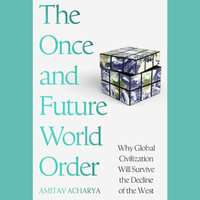
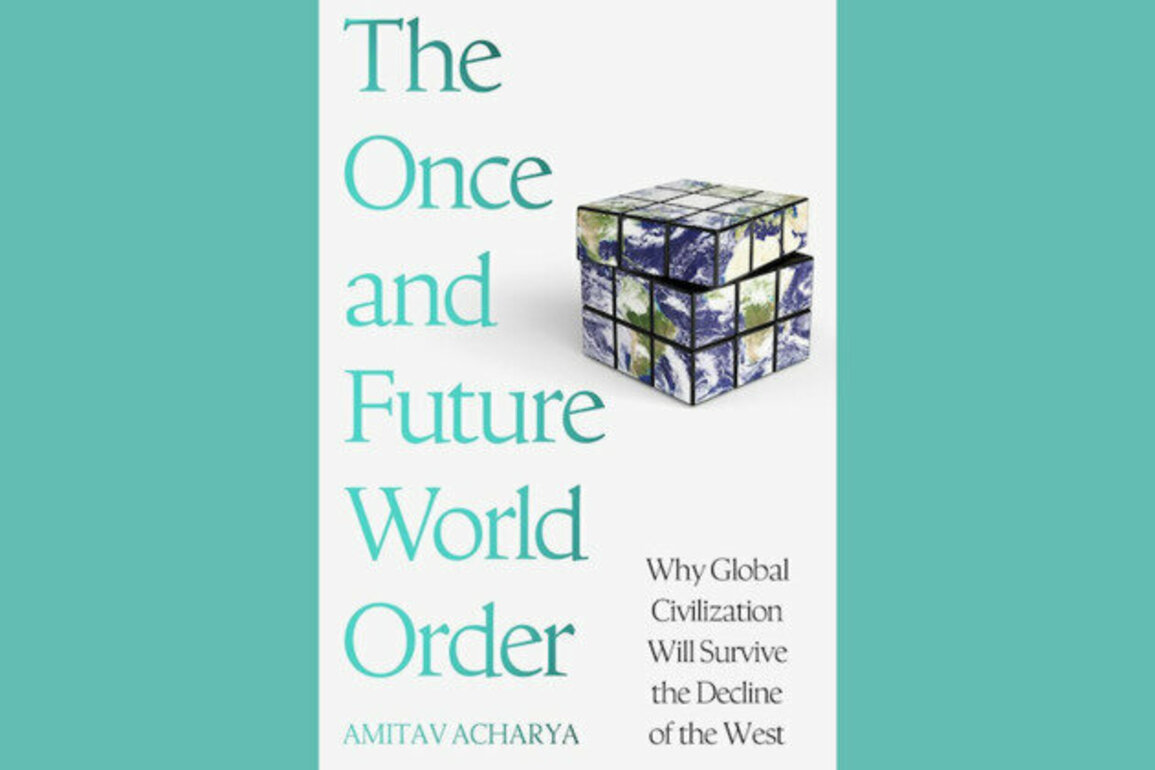
viewsImage by Basic BooksThe Once and Future World Order: Why Global Civilization Will Survive the Decline of the West
By Amitav Acharya
Basic Books, 2025
Amitav Acharyas The Once and Future World Order: Why Global Civilization Will Survive the Decline of the West offers a panoramic review and perceptive reflection on the holistic macrohistory of humankind. It invites readers to embark on a cross-cultural journey over the past five thousand years of human history across a pluriverse of civilizations, both Western and Non-Western. They include Non-Western civilizations like Egypt, India, China, Persia, and the Islamic World, and Western civilizations such as the Roman Empire, Byzantine Empire, and ancient Greece. The contributions from discontinued or lost civilizations like the Incas and Aztecs, and hitherto marginalized cultures such as African peoples, are also incorporated into Acharyas conception of a multi-centered world order.
The central themes of Acharyas book are threefold. First, it questions and challenges the Eurocentric underpinnings of the modern international system through exposing the racist, colonialist, and imperialist foundations of contemporary world order. Second, it broadens and expands the conceptualization of world order beyond its parochial West-centrism, through subsuming Greco-Romanian, Western history into a global and multicivilizational narrative framework that explicitly embraces the world order-building contributions from diverse non-Western civilizations. Third, it underscores humanitys cross-cultural linkages and shared humanistic heritages, to spell out possible pathways for the realization of a more humane, just, equitable, inclusive, and sustainable world order.
The key factor that empowers Acharyas work to stand out is that the book transcends culturally exceptionalist narratives that focus solely on the worldviews of a particular nation or civilization, such as John Fairbanks narration of a Chinese World Order and John Ikenberrys conception of a US-centric liberal world order. Ascending beyond essentialized civilizational imaginations of world order, especially Samuel Huntingtons Clash of Civilizations thesis, which presumes a world of mutually impenetrable and diametrically irreconcilable civilizations, Acharyas conceptualization of a multiplex global order is anchored on the ideational contributions of both Western and Non-Western civilizations across a timespan of more than five millennia.
Equipped with its pluralistic and inclusionary outlook, the book could be perceived as an eye-opener to students of social and political science. Presently, the international relations (IR) disciplines core textbooks and common pedagogical toolkits are still heavily imprinted with Western philosophical, ontological, and cultural traits. One example is the Thucydides Trap metanarrative, which superimposes ancient Greeces Peloponnesian War onto contemporary US-China relations to predict a great power conflict between the two superpowers. In challenging a Eurocentric metanarrative like the Thucydides Trap, Acharyas macro-historical narrative provides strong evidence of peaceful coexistence between ancient great powers like India and China.
As Acharyas book adopts a multicivilizational and macro-historical perspective, it offers a powerful critique to deconstruct the creationist myth of the contemporary international order. One well-known example is IRs foundational myth that the European Peace of Westphalia in 1648 marks the beginning of a Western-led universal world order. In challenging and broadening such Eurocentric narratives, Acharyas work shows that world order did not burst out like a Big Bang from one particular time period in history or diffuse in unilinear fashion from a specific geo-cultural locale to the rest of the world.
Instead, Acharyas book shows that the core ideals, normative principles, and institutional practices of world order are cocreated by a multiplicity of civilizations, through their continued intercultural diffusions and shared sociohistorical heritages. For example, freedom of maritime navigation, a core principle enshrined in the United Nations Convention on the Law of the Sea (UNCLOS), is traceable to the Indian Ocean network, which was not owned or territorially demarcated by any single nation-state. In the absence of an exclusive maritime sovereignty, multicivilizational polities such as India, China, Persia, Srivijaya Kingdom, and the Malaccan empire traded and exchanged ideas through crisscrossing naval routes stretching from Eastern Chinese coastal ports to East Africa.
Importantly, Acharyas intervention illuminates that the progressive advancement of a global civilization is the product of intercultural diffusions and cocreational ideations. For example, the European Enlightenments characteristic idea of scientific reasoning was significantly influenced by the philosophies of classical Islamic thinkers, such as Ibn Khaldun and Ibn Rush. The laissez-faire principle of neoliberalisms free market economy could be traced to the Daoist philosopher Lao Tzus notion of wu wei (), which means non-action or acting effortlessly. The multicultural origins and evolutions of human societies imply that certain core concepts of contemporary global governance, such as human development and collective security, ought to be enriched by the ideational contributions from pluralistic civilizations.
Nevertheless, despite the overall success of Acharyas book in redressing Western dominance in international studies, it arguably incurs one noticeable limitation. To a certain degree, Acharya has not specifically pointed out what each Non-Western civilizations contribution(s) are that are travelable and applicable beyond its cultural origins, in the construction, maintenance, and evolution of world order at large. For example, when dealing with ancient Indian political thought, Acharya has highlighted the contrast between Kautilyas realpolitik practices and King Ashokas non-violent doctrine of Dharma, a Hindu philosophical doctrine on cosmic harmony and social order. And yet, it appears that Acharya did not specifically expound on how Kautilyas realism and King Ashokas idealism are correlated to the building of a universal world order. Likewise, when contrasting ancient Chinas Confucian thought and legalist doctrines, Acharyas interpretation falls short of relating these ancient Chinese philosophies to the conceptualization of a universally shareable world order.
On the whole, however, The Once and Future World Order is a timely scholastic work to help visualize the multicivilizational foundations, shared ideations, and evolutionary trajectories of contemporary world order. Through worlding beyond the narrow prism of West-centrism, the book inspires current and future generations of scholars to make contributions to the envisioning and moulding of a universally inclusive global order.
Further Reading on E-International Relations
- Interview Amitav Acharya
- Review World Statehood
- Review The New World Disorder and the Indian Imperative
- Review The Making of Global International Relations
- Review Future Politics: Living Together in a World Transformed by Tech
- Review Critical Feminist Justpeace
About The Author(s)
Bo Yuan Chang is a PhD candidate in Political Science and Civics at the Department of International and Strategic Studies, University of Malaya. His doctoral thesis adopts Chinese Humanism as the central integrative framework to interpret, analyze, and criticallyreviewcontemporary Chinas international relations (IR) theories. His research interests include Non-Western and Chinas IR Theories, ancient Chinese philosophies, and contemporary global governance.
Editorial Credit(s)Kihyun Kim
TagsCivilizationsEurocentrismGlobal GovernanceInternational Relations TheoryMultiplexityWorld Order